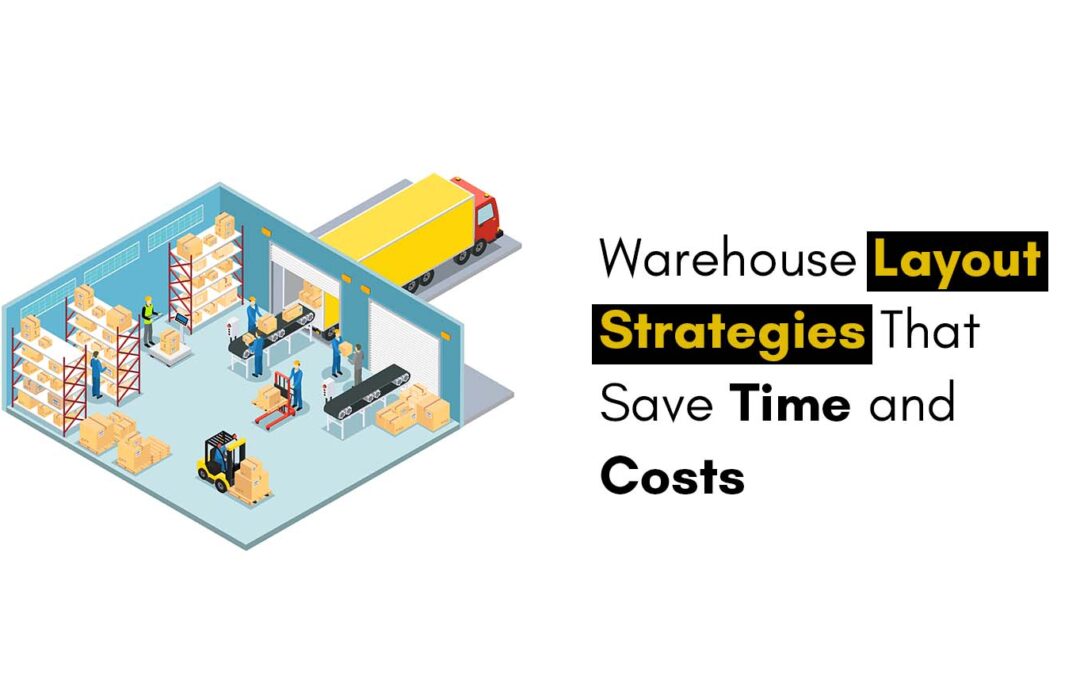
Optimum warehouse layout is an essential component for efficient logistics, which further affects productivity indirectly, in addition to the costs of operations. A proper design for a warehouse layout for maximum optimisation for workflow, maximum utilisation for available spaces, and minimum wasteful movement can save a lot of time as well as costs.
Another classic design method is the use of a U-shaped layout. This arrangement places receiving and shipping docking close together so cargo flows easily in a straight line from arrival to storage and promptly outward again without crossing over in the warehouse. That helps keep travel distances low, handling at a minimum, and gets more shipments turned around. That configuration is effective in warehouses with cramped space or smaller warehouses with high in-and-out shipment frequencies.
Otherwise, an I-shaped design balances shipment and receiving units on either side of a warehouse at opposite ends with a straight-line flow within a warehouse. That is a simple, uncomplicated design best fit for operations when large lot sizes are employed with steady, consistent flow. Products are easy to track in such a design since receiving and shipping are isolated.
For warehouses with certain space limitations or for cross-docking applications, an L-shaped facility works best. Here, receiving as well as shipping docks are positioned next to each other on nearby walls, frequently with storing panels in the L corner. Such a design facilitates easy movement between incoming and outgoing trucks quickly, accelerating processes while maintaining low warehousing requirements.
Dividing up the warehouse into dedicated zones is also efficient in its own right. These can be product-type, picking-frequency, or handling-requirement-based. Fast sellers are stored near shipping docks for ease of immediate access, while bulk or slow-movers are stored remotely. Special temperature- or hazardous-material-type zones are best for maximizing safety regulations. Such zoning is best for reducing picking times as it optimizes flow in general.
Another key methodology is vertical height maximization. By implementing pallet racking, mezzanines, and multi-level shelf units, product capacity is achievable with no increased footprint in a warehouse. The vertical storage not only achieves maximum capacity but also keeps aisle spaces vacant for hassle-free and safe movement for individuals as well as machinery. Fitted with appropriate materials handling equipment, like forklift trucks as well as automated retrieval units, vertical maximization is further augmented in picking throughput, along with accuracy.
Reducing picking routes and processes even further saves even more costs in addition to saving time. As a rule of thumb, distances between travel for picks are decreased by storing frequently ordered items in proximity. Based on order behavior, batch picking, zone picking, or wave picking can be integrated. Automation technologies such as pick-to-light, voice picking, or mobile device scanning also improve accuracy in addition to operators’ productivity.
Good lighting, effective signage, and clearly marked aisles permit worker productivity and safety. Workers can quickly identify articles and move throughout the facility without disorientation, reducing errors and physical stress. Up-to-date warehouse maps and electronic inventory information permit such in-plant improvements.
Flexibility is required for a layout to stay affordable as conditions in a business evolve. Convertible shelving, modular stock units, and changeable sections allow for a rapid redesign. Such flexibility is for soaking up seasonal bulges, complementary product lines, or shifting operating strategies without large expenses or downtime. In addition, integration with warehouse management software (WMS) enables real-time locationing of stock levels, order status, and points of workflow bottlenecks. Data-driven intelligence enables dynamic layout and process tweaks for constant maximum efficiency.
As a whole, a strategic warehouse design ensures minimal extraneous movement, accelerated order throughput, maximum use within available space, and greater worker safety, all equating to spectacular time savings and cost reduction. Through integration with a combination of smart design principles, zoning, vertical storing, picking optimization, and technology solutions, warehouses are in a position to redesign their operations for greater interest in meeting tomorrow’s logistics needs more profitably.