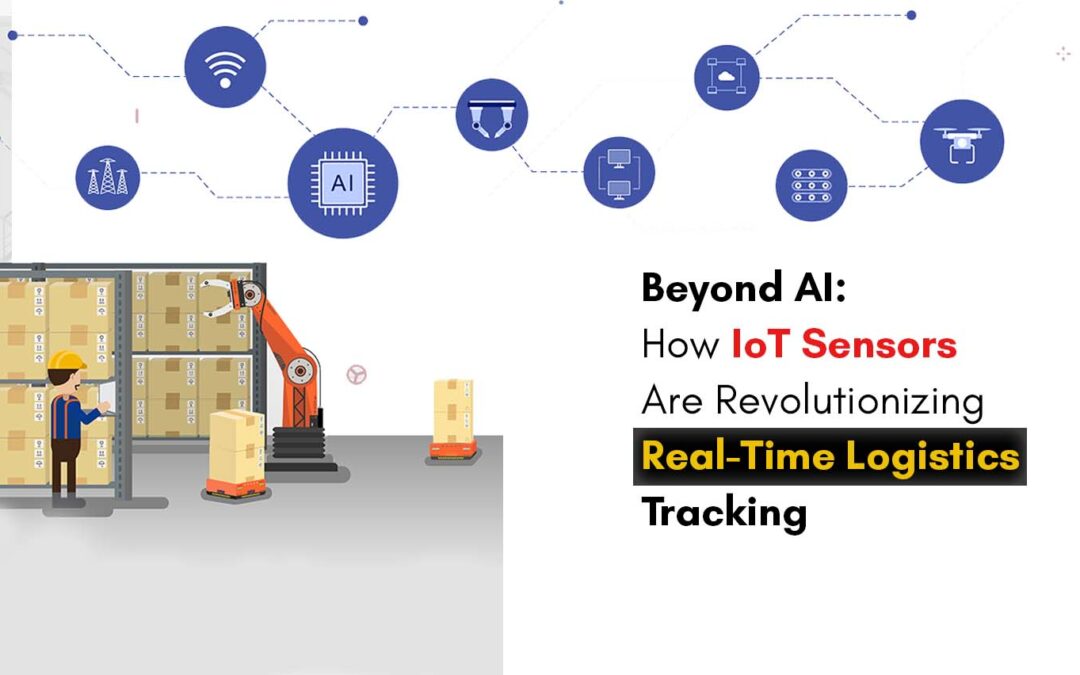
In the logistics industry, Artificial Intelligence (AI) has proven useful for route optimization, demand prediction, and decision automation. However, the noteworthy difference-maker now exists in the partnership of AI with Internet of Things (IoT) sensors, introducing real-time visibility and finer control to every segment of the supply chain.
In this article, we will clarify how IoT sensors can supply next-level logistics tracking, including some advantages and disadvantages, and how logistics suppliers can utilize them to supply a high level of service.
What are the Differences between IoT Sensors and AI
Continuous, real-time data streams: AI models rely on historical, batch data, IoT sensors deliver real-time data such as temperature, humidity, vibration, and location to help drive immediate action to changing conditions.
Edge intelligence & local decisioning: Most new IoT devices contain some edge computing capability, enabling localized filtering, alarm triggering, or simple decision logic (e.g. if temperature > threshold then send alert).
Granularity & context: Instead of having coarse metrics (e.g. “the truck is late”), IoT provides you with real-time information concerning exactly which container, which pallet, or which compartment is outside acceptable parameters.
Integration with AI & analytics: The real advantage is when IoT data feeds AI modeling and real-time forecasting, anomaly detection, and optimization activity.
Key Use Cases: What IoT Sensors Enable in Real-Time Logistics
Asset & Fleet Tracking
GPS trackers, accelerometers, and motion sensors enable monitoring of vehicle location, speed, route deviations, and dwell time; which can facilitate dynamic rerouting, more accurate ETAs, and delays being minimized altogether.
Cold Chain / Temperature Sensitive Goods
For pharmaceuticals, food, chemicals etc., sensors measuring temperature, humidity and CO₂ are paramount to success & compliance. Alerts can be sent when conditions deviate from set parameters, protecting product integrity.
Shock & Vibration Monitoring
For packages or delicate items, accelerometers or shock sensors may be applied. If a container has been dropped, or the product has been shaken excessively, a system may flag when, where, and how the item was disturbed.
Security & Tampering Detection
Sensors can detect door openings, seal breaks, and unauthorized access. When combined with geofencing, one can be alerted if the cargo is tampered with or route is diverted.
Warehouse & Storage Monitoring
Within a warehouse environment, sensors monitoring racks, shelves, or pallets can track the movement of the contents. In addition, ambient conditions, RFID/ultra wideband trackers, etc. can also be selected. Overall, it helps companies better utilize space as well as reduce repair/loss.
Benefits of IoT Powered Real-Time Tracking
- Improved visibility & transparency – Stakeholders, including the shipper and customer, can see a live status of a shipment, improving uncertainty and building trust.
- Proactive problem identification & resolution – Rather than uncovered damage or spoilage at the destination, logistics teams can proactively intervene en route (reroute, change cooling, etc.).
- Easier routing & resource use – With live data on traffic, location and state of the assets, routing becomes a far more dynamic exercise, enabling redundancy at congestion points or unsafe routes.
- Lowering operational costs & waste – Fewer delays, less spoilage, less damage and fewer checks translates into lower operational costs as well as waste.
- Better customer experience – Accurate ETAs, fewer surprises and real-time updates are most appreciated by customers, while potentially lowering customer support operations.
Challenges and Considerations
Connectivity & network reliability
IoT devices often depend on cellular, satellite or LPWAN (LoRa, NB-IoT). Remote or underground routes could suffer from coverage gaps.
Energy & power considerations
Many sensors are battery powered. Designing equipment and software for low power consumption, long lifetime or harvesting energy is most critical.
Data overload & filtering
Sensor data often comes in massive volumes and often needs cleaning, filtering or aggregation. Without solid edge processing, backend systems can be bogged down by the volume of data.
Security & privacy risks
IoT endpoints can be vulnerable to hacking, data manipulation, or spoofing. Strong encryption, secured firmware updates, and network isolation will be critical to address these issues.
Interoperability & standardization
Devices provided by different manufacturers may be wireless and use different protocols. Adoption of flexible middleware to allow plug and play communication and using open standards where they make sense to drive interoperability will be most important in solving trouble areas.
Looking Ahead IoT + AI Edge Intelligence
In the future, we will see a combination of IoT + AI + Edge Intelligence. AI models operating initially at the edge and using sensor data will have the ability to optimize routing, identify exceptions, and repair themselves, all without dependency on a cloud interface. Implementing these next-generation technologies will allow them to be competitive and present itself as a technology-driven logistics provider.
Conclusion
IoT sensors are not simply “nice-to-have”, sensors provide a foundation for enabling a shift from re-active to pro-active, visible, and intelligent logistics. By enabling real-time sensing with AI, logistics providers can deliver precision, dependability, and trust in a way that clients expect.