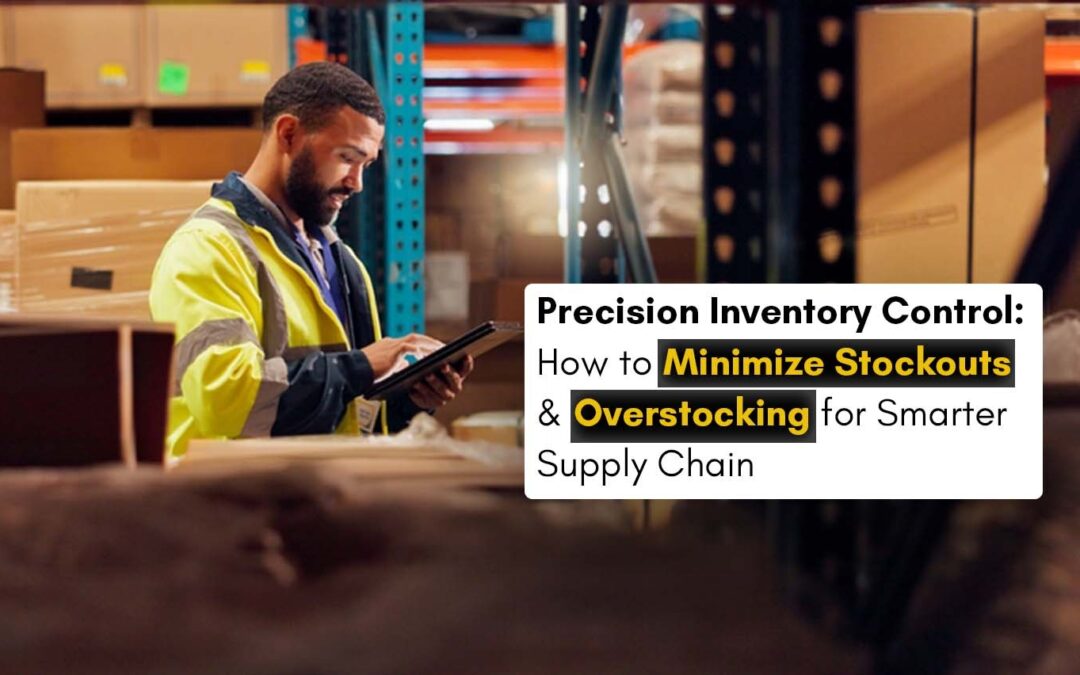
Inventory management within your supply chain is the cornerstone of managing a lean, efficient business. Whether you are a hyper-growth startup, or just a business that has been around for a while and is trying to optimize the operations, it is an expensive endeavor to manage inventory defensively somewhere between stockouts and overstock scenarios. In this post we will discuss some options for how to manage inventory levels to achieve the best service levels possible while trying to minimize actual inventory carrying costs.
The Risk of Both Stockouts and Overstocking
- Stockouts end up resulting in missed sales/lost customers, and possibly damaging your brand equity for the long-haul.
- Overstocking results in tying up your cash, ends up costing more to store and handle; leaves your inventory at-risk of spoilage or obsolescence, and ultimately lower net efficiency.
Finding the right settle point in between stockouts and overstock is not only an art but a science. It takes demand planning, safety stock modeling, creating metrics that can be monitored to watch actual inventory shifts, and creating systems that can lend visibility in real-time.
1. Classification of Inventory
Before you can really start a process of inventory level optimization, it is helpful to classify your inventories:
- Cycle stock – this is simply your standard cycle inventory driving your known demand signals in.
- Safety Stock – this is simply your finished goods that serve as buffer inventory signal into higher-than-standard demand and/or ensure that you won’t run out of-stock on a specific item due to timing delays or shortages.
- Pipeline Inventory – this is inventory that is either in transit or in your processes.
- Pre-build inventory – this is inventory that is built-ahead of time; responding to known signals and known upward projections of demand, sourced seasonally during festivities or other promotional sales.
Understanding the types of inventories you have will help build your confidence in making an inventory decision; rather than considering one classification for everything inventory-related.
2. Enhance Demand Forecasting & Data Visibility
Poor forecasting is one of the main causes of stockouts and overstocks. Here are some strategies to improve it:
- Use historical sales data and sales seasonality patterns for your demand model.
- Make sure your demand forecasting model includes lead times and reliability of suppliers as additional metrics.
- Monitor trends, promotions, and other influences like holidays or supply chain disruptions, as they all impact demand for your products.
This data visibility gives you perspective to see where inventory is stuck or running low and how to immediately respond by pre-emptively restocking or moving inventory within your network.
3. Determine Appropriate Safety Stock Levels
Safety stock is effectively your insurance policy. However, too much buffer equals the cost of overstocking. Too little buffer equals potential stockouts.
- Calculate appropriate safety stock based on demand variability, lead time variability, and desired service level.
- Use your safety stock calculations to adjust dynamically through the week or season as variabilities change (i.e. supplier delays, seasonal spikes, or introduction of new products).
- Don’t use a fixed buffer based on an intuitive guess; instead try adaptive buffers.
Confirmed safety stock levels can be included in your breakdown of inventory types (cycle stock, safety stock or pipeline inventory) as a risk to your business operations.
4. Implement Smart Reordering Policies with Automation, Eliminating the “Gut Feel” Process
Reordering inventory manually based on “gut feel” is generally inaccurate and inefficient. Instead, determine reorder points (ROP) in your inventory management process, model ROP based on mathematical calculation and/or assign predetermined ROP based on if that works in your context.
Using reorder quantities to include in your reordering methodology should be determined by balancing ordering cost and holding cost (e.g. Economic Order Quantity – EOQ – modeling).
Automating replenishments, and/or if your operation is large enough, automating how much and when to reorder triggers. Utilizing your WMS (Warehouse Management Systems) or inventory management module to set reorder triggers is an effective example of automation.
5. Optimize Storage Layout & Warehouse Practices
Inventory management isn’t simply about numbers, it is also about how and where stock is stored; this can impact the efficiency of how orders are fulfilled, how items can be moved, and how waste is reduced.
- A good warehouse layout will minimize how long it takes to handle product, improve picking efficiency, and lower labor costs.
- Consider zoning or ABC analysis layout (i.e., fast-moving product is placed near picking points).
- Implement Best Practices in Warehouse Layout.
Innovative storage ideas (e.g., vertical racks, mobile racks) allow you to be flexible with changes in your SKU mix while avoiding clutter.
The efficiencies realized in layout translate directly to your ability to respond quickly to demand changes, without overstocking the “just in case.”
6. Monitor & Review Key Metrics Regularly
To keep your inventory precisely tuned, you need continuous feedback. Some KPIS to watch:
| Metric | What It Tells You |
| Stockout Rate | Frequency or percentage of time demand could not be met |
| Inventory Turnover | How many times inventory is used up or replaced over a period |
| Carrying Cost as % of Inventory Value | How much it costs you to hold stock (storage, capital cost, obsolescence) |
| Order Lead Time Variability | Variations between expected vs actual supplier or inbound timing |
| Service Level | The probability that you can meet demand without stockout |
7. Adapt to Risk & Disruption
Today’s supply chains are vulnerable to disruption, whether that be natural disasters, raw materials not arriving on schedule or being lost in shipping. You can build resilience into your inventory control by doing a few thing:
- Have contingency buffers for critical SKUs.
- Diversify your supplier base and negotiate flexible supplier terms.
- Review your risk mitigation plans.
- Leverage flexible warehousing models. Flexible Warehousing Is Essential in a Changing Market.
Resilience gives you protection against sudden stockouts, without having to permanently maintain lots of inventory.
Conclusion
Minimizing stockouts and excessive stock isn’t a one-off task, but rather a continual process of assessing, refining, and ultimately making smart decisions. Companies—those that can safely claim precision inventory control, distinguish themselves by effectively combining accurate demand forecasts with visibility of stock levels in real-time, keeping their safety stock levels lean, automating their reorder process, and constructing what is likely to be the most efficient warehouse design. Compounding those advantages are the regular monitoring of performance within the business, risks mitigation, and the ability to respond quickly to changes in demand and supply chain disruptions. Lastly, if done correctly, inventory management changes from a cost-burden to a competitive advantage that creates potential for profitability, customer satisfaction, and operational agility. If a company does undertakes all that and is seeking expert help in maximizing their inventory and warehousing systems, the next logical step could be to learn more about FWD Space’s Inventory Services
and Warehousing Management Solutions, to achieve precision inventory control.